
The disengagement of troops of the Indian Army and China's People's Liberation Army from the Line of Actual Control was reached after sustained negotiations at the military and diplomatic level, said the ministry of external affairs last week.
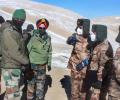
'We hope the Indian side will work with China to follow through the important consensus of our two state leaders, abide by relevant agreements and treaties to de-escalate the tension at the border'

Defence Minister Rajnath Singh on Saturday said India has never attacked any country out of hatred or contempt but if its interests are threatened, 'we will not hesitate to take a big step'.

His statement came in the backdrop of media reports of construction of a ropeway at Torsa Nala near Doklam by the Chinese People's Liberation Army.

Chinese Foreign Minister Wang Yi has expressed readiness to join hands with India's National Security Advisor Ajit Doval to "properly handle" issues related to the situation on the ground in the border areas, amid the protracted border row in eastern Ladakh.

In the meeting, Doval conveyed to Wang that peace and tranquillity in border areas and respect for the Line of Actual Control are essential for return of normalcy in bilateral ties, according to the ministry of external affairs.

Companies typically face challenges in recruiting candidates who are skilled in AI, machine learning and generative artificial intelligence though they have hundreds of vacancies.
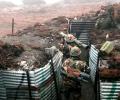
The Chinese military on Thursday said the situation along the India-China border 'at present' is 'generally stable' and both sides have maintained 'effective' communication to resolve the military standoff in eastern Ladakh.

This is the first time that the defence ministry has admitted officially about the transgressions by the Chinese troops.

Defence Minister Rajnath Singh on Thursday held talks with his Chinese counterpart Li Shangfu and is learnt to have discussed the lingering border row in eastern Ladakh.

The participants would include senior ministers dealing with the situation along with the senior military leadership. The leadership is likely to discuss the Chinese military activities in Doklam and other areas on Bhutanese soil along with the Indian preparations to deal with the situation.

China on Tuesday announced that its Defence Minister General Li Shangfu will visit India this week to attend the meeting of SCO defence ministers from April 27 during which he is expected to hold talks with his Indian counterpart Rajnath Singh on ending the prolonged eastern Ladakh standoff which has severely strained bilateral ties.
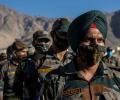
A joint statement released on Thursday said both sides exchanged views in an 'open and constructive' manner to resolve the 'relevant issues' and that it was agreed to maintain 'security and stability' on the ground in the region.
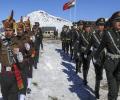
Sources said the process of disengagement along the Line of Actual Control is "complex", and in such a context, speculative and unsubstantiated reports need to be avoided.

The high-level talks came a week after 20 Indian Army personnel were killed in a violent clash between the two sides in Galwan Valley.

as journalists active in Pakistani media have been quick to point out, with Ghafoor at the helm in Balochistan, no one will take seriously any claims by the civilian leadership to use the velvet glove to work for peace there, points out Rana Banerji, who headed the Pakistan desk at the Research and Analysis Wing, India's external intelligence agency.He did not hesitate to pejorate developments in India at the slightest opportunity, points out Rana Banerji, who headed the Pakistan desk at the Research and Analysis Wing, India's external intelligence agency.

'The Indian Army is fully prepared for a long and permanent deployment if the PLA does not retreat.'

The naming of the places in memory of the soldiers comes days after Chinese military commander Qi Fabao, who was injured in the Galwan Valley clash with Indian troops in June, 2020, attended the ruling Communist Party of China's (CPC) Congress as a delegate.
Another round of diplomatic talks under the framework of the Working Mechanism for Consultation and Coordination is expected to be scheduled soon.

Pakistan's Defence Minister Khawaja Asif on Wednesday said the government is mulling a possible ban on Imran Khan's Pakistan Tehreek-e-Insaf party following the attacks by his supporters on military installations after the former prime minister's arrest.

China and India have maintained "candid and in-depth communication and coordination" to promote disengagement in areas along the Line of Actual Control (LAC) in eastern Ladakh after the eighth round of talks to resolve the current standoff, the Chinese military said on Thursday.

Sources indicated that during Saturday's talks, India will insist on a faster disengagement process in remaining areas to bring down tension in the region, which has witnessed a tense standoff between the two militaries for over nine months.
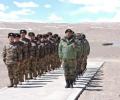
The sources said the ongoing engagement and dialogue at military and diplomatic levels have resulted in complete disengagement of troops at patrolling point 14, 15 and 17 A in eastern Ladakh.

The meeting will take place in Chushul sector on the Indian side of Line of Actual Control.
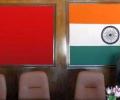
The Indian delegation at Thursday's talks is likely to be led by Naveen Srivastava, Joint Secretary (East Asia) in the external affairs ministry, they said.
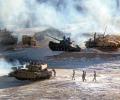
'The Chinese are only about 160-170 km behind.' 'It will not take much time for them to bring their troops back, considering that they have better infrastructure -- and the weather is now favourable.' 'They can move in much faster as the terrain favours them.'

The Indian Army on Friday strongly insisted on early disengagement of troops by China from all the friction points in eastern Ladakh at the eighth round of corps commander-level talks between the two sides that primarily focused on a roadmap for restoration of peace and tranquillity in the region, according to people familiar with the developments.
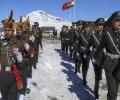
The disengagement plan was discussed between the two sides during the 8th Corps Commander-level talks which were held on November 6 in Chushul.

The next phase of the de-escalation process will kick off only after the fourth round of talks between corps commanders of the two sides.

The Jaishankar-Wang talks came amid the dragging border row in eastern Ladakh that entered its fifth year in May.
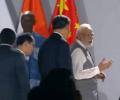
Prime Minister Narendra Modi conveyed to Chinese President Xi Jinping India's concerns on the "unresolved" issues along Line of Actual Control (LAC) in eastern Ladakh during a conversation on the sidelines of the BRICS summit, Foreign Secretary Vinay Mohan Kwatra said on Thursday.
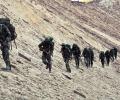
China and India have made 'positive progress' to resolve the border standoff, with both sides maintaining close communication through diplomatic and military channels, a senior foreign ministry official said in Beijing on Friday.
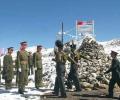
China on Wednesday said the latest round of the border talks with India was held in a "candid and pragmatic atmosphere" and the two sides had a "positive, constructive and in-depth discussion" on the resolution of the remaining issues along the Line of Actual Control in the Western Sector.
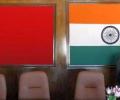
China said that "sound and stable ties" serve the common interests of China and India.

It seems that the People's Liberation Army (PLA) is not in a mood to de-escalate the situation on the Line of Actual Control (LAC) as it has continued deployment of around 40,000 troops in its front and depth areas for the Eastern Ladakh sector.

Chinese Foreign Minister Qin Gang reiterated that the situation at the India-China border is generally stable and both sides should consolidate the present achievements and strictly abide by the relevant agreements while pushing for further cooling and easing of the conditions for sustainable peace and tranquillity at the frontier.
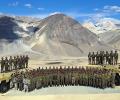
If China is accommodating regarding Depsang and Demchok, a resolution of the Sino-India territorial dispute in Eastern Ladakh could be possible.
China has said that the disengagement of troops in eastern Ladakh by the Chinese and Indian armies is going on "smoothly" following a recent agreement between the two nations.

'Given China's past behaviour and their territorial claims, should we be sceptical regarding China's willingness to adhere to these agreements fully? The answer is yes.' 'As Ronald Reagan famously said in the context of the SALT talks, 'Trust, but verify!' India should also do the same.' 'This has already begun with foot patrolling, drones, satellite imagery and so on. India's military deployment did mirror China's and will continue to do so in the future.'
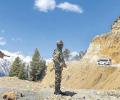
The meeting primarily focused on implementation of certain decisions taken at the fifth round of talks between Corps Commanders of the two armies last week on the disengagement process as well as to bring down prevailing tension in the region, sources said.
